
I visited for you… the National September 11 Museum
The National September 11 Museum opened in May 2014 at the exact site where the World Trade Center towers once stood. Here's what you'll find inside.
What to expect when visiting the 9/11 Museum
- From the outside, the National September 11 Museum looks surprisingly small. Once you pass security—similar to airport screening—you realize the entire museum is built underground. As you take the escalator down to the exhibition level, look to your right: you’ll see steel beams from the original World Trade Center and, through the glass, the new One World Trade Center. This juxtaposition sets the tone immediately.
- At the bottom of the escalator, you enter the museum’s main hall. To the left, a dark corridor draws you into September 11 with a large map showing the flight paths of the hijacked planes, photographs, and audio. At the end of the corridor, a narrow platform overlooks the foundations of the former twin towers. This sudden perspective is striking. What becomes clear is that the museum was built within the very foundations of the original towers, and the two main exhibition halls occupy the exact footprint where the towers once stood—directly beneath the memorial fountains. It’s a powerful realization, especially for those who remember the towers.

The Foundation Hall in the 9/11 Museum
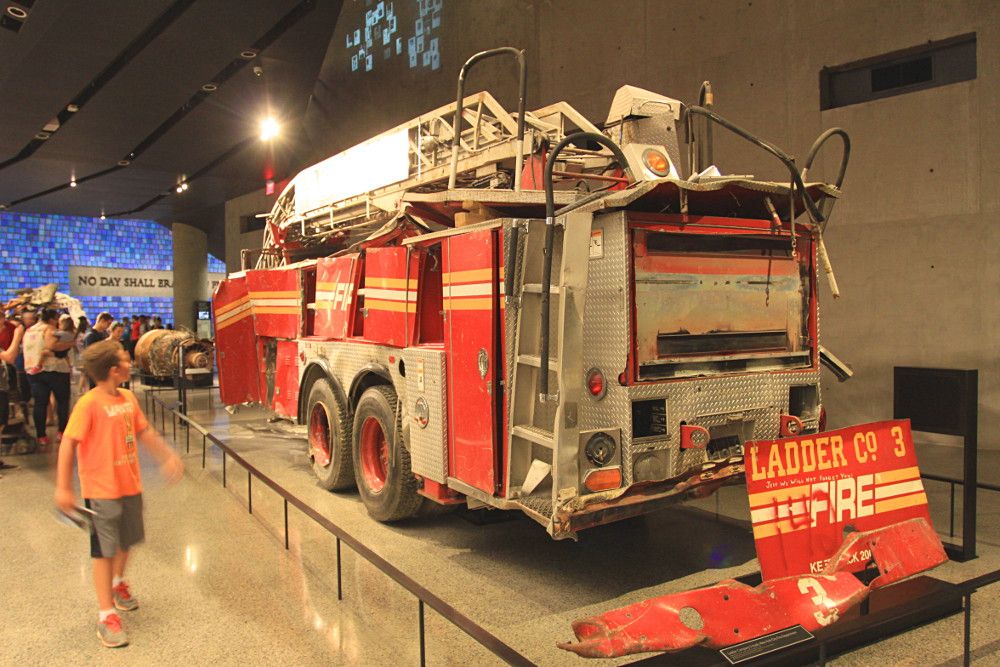
- A staircase leads to the lower level. At the bottom, you’re left to navigate on your own. Head left toward the Foundation Hall to approach the foundations directly. On the way, you’ll pass several artifacts recovered from the debris: a section of the North Tower antenna and, most strikingly, a fire truck with its front completely crushed. The relics from September 11, 2001 are deeply moving.
- In the Foundation Hall, you can view a massive steel beam from the World Trade Center. It’s covered with inscriptions carved by the rescue workers and laborers who cleared Ground Zero.

The September 11, 2001 Exhibition
- Now it’s time to explore the two main exhibition halls: the Historical Exhibition and the Memorial Exhibition. Start with the Historical Exhibition, which chronicles September 11, 2001 in detail. This chronological approach helps you understand the sequence of events before moving to the second exhibition, which honors the victims.
- The exhibition opens with a small room that recreates the morning of September 11, 2001. It was a beautiful day in New York—clear skies, brilliant sunshine. Newspaper clippings set the scene. Then a television screen shows a cheerful broadcast interrupted by breaking news: a plane has hit the North Tower of the World Trade Center. The beginning of a day of horror.

Radio transmissions
- The exhibition is comprehensive and well-documented, with artifacts, photographs, and video. The timeline follows the first plane crash, then the second, then the Pentagon strike, then the crash in Pennsylvania after passengers attempted to regain control. You can listen to or read the final phone calls passengers made to loved ones—heartbreaking messages. The hours unfold with detailed accounts of rescue operations, including radio transmissions between firefighters.
- In one corner, a small room marked with a warning contains photographs of people who jumped from the towers. The accompanying text explains how these men and women had no choice as smoke filled the upper floors. If you’re sensitive to disturbing images, skip this room—the photographs are extremely graphic.
The CIA and the Cold War
- The exhibition continues with the collapse of the towers. The museum displays numerous objects recovered from the debris and, alongside accounts of horror, shares remarkable stories of survivors.
- I spent several hours in this exhibition alone. After the tower collapse, I thought the visit would end there. But it didn’t—and that was a genuine surprise. The exhibition then traces the hijackers’ backgrounds and explains how we arrived at this moment. The museum has the courage to address difficult history directly: it explains how the CIA supported Afghan mujahideen during the 1979 Soviet invasion by funding and arming them. The historical truth is laid bare. It took real integrity to present this in such a museum, at the heart of Ground Zero, and the museum’s creators deserve credit for it.
- The September 11, 2001 attacks are not presented only as the events of that day—the collapse of America’s iconic towers and the deaths of nearly 3,000 people. The museum also examines the conditions that gave rise to this Islamic terrorism. It recalls bin Laden’s multiple threats before 2001, the 1998 bombing of the U.S. embassy in Kenya, and the 2000 attack on the USS Cole off Yemen. Spend time with this section of the exhibition: it places September 11 within its broader context and the complexities of international politics.
Honoring the victims at the 9/11 Museum
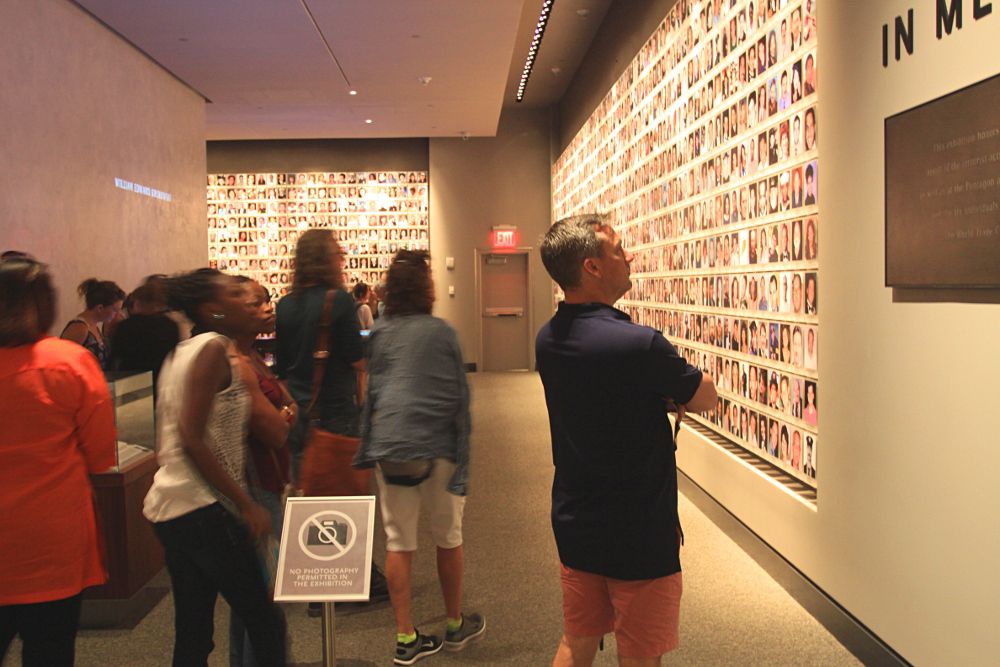
- After the chronological account, move to the Memorial Exhibition, which honors the victims of September 11, 2001. The walls display photographs of all the victims from that day—from New York, Washington, and Pennsylvania. The museum also includes the names of the six people killed in the 1993 World Trade Center bombing.
- Seeing all these faces creates an immediate human connection. The 3,000 victims of September 11, 2001 are no longer a statistic but individual lives cut short. Interactive screens let you learn more about each person. You can search by name or by nationality, and you’ll see that the world was touched—the victims came from many countries.
- The room also displays personal items belonging to the victims: access badges from the World Trade Center, eyeglasses, a mobile phone. And a stuffed animal that belonged to the youngest victim.
- Overall, I found the National September 11 Museum to be a remarkable achievement—in its architecture, its design, and its commitment to historical truth.
5 tips for visiting the National September 11 Museum
- 1/ Arrive at opening time
Open daily from 9 am to 8 pm (9 pm Friday and Saturday), the 9/11 Museum is now one of New York’s most popular attractions. To avoid long lines and crowds inside, arrive at 9 am and be among the first visitors of the day. - 2/ Use the CityPass or Explorer Pass for skip-the-line access
To save time at the entrance, get the CityPass: it includes museum admission plus skip-the-line access. You can book it on the CityPass New York page. You can also access the museum with the Explorer Pass New York, which also offers skip-the-line entry. - 3/ Use the coat check
In the main hall at the bottom of the stairs, turn left and head to the coat check to leave jackets, bags, or umbrellas. It’s free and lets you move through the exhibition without carrying your belongings. - 4/ Take your time
The museum’s exterior doesn’t hint at how much it contains. Inside, the September 11, 2001 exhibition is a rich collection of information and documents. Many audio recordings and videos are rare. I spent nearly 3 hours here and didn’t notice the time passing. - 5/ Browse the museum shop
Like other New York museums, the 9/11 Museum has a shop with a wide selection of books about the attacks and the World Trade Center. Tip: profits from shop sales support the museum and memorial’s maintenance and development. It’s a good place to buy postcards and souvenirs.