
I visited for you… the Ground Zero Museum Workshop
The Ground Zero Museum Workshop is a museum dedicated to September 11, 2001 that's well worth a visit. A unique experience!

A Personal Museum About September 11, 2001
- Although it is also dedicated to the September 11, 2001 attacks, the Ground Zero Museum Workshop is completely different from the National September 11 Museum. Apart from the subject matter, you could say they are opposites in almost every way. The National September 11 Museum is a large public museum located on the World Trade Center site itself, while the Ground Zero Museum Workshop is a tiny private museum in the Meatpacking District. So small that I walked right past the entrance without noticing it!
- To visit, you must book your ticket in advance because this is actually a guided tour (you can book directly on the Ground Zero Museum Workshop page). Arrive at the agreed time at 420 West 14th Street, between 9th Avenue and Washington Street. To find the museum entrance, look for a small sign on the sidewalk, just across from a door with an intercom. If you’re the first to arrive, ring the bell; otherwise, wait for others.
What Is the Ground Zero Museum Workshop Tour Like?
- A few minutes before the tour starts, a young guide comes down to greet you on the sidewalk and briefly explains the museum’s concept. The Ground Zero Museum Workshop was founded by Gary Marlon Suson, a photographer who was chosen in 2001 as the official photographer for the fire department. In this role, he was the only photographer allowed to document the cleanup operations, apart from New York police forensic photographers whose images were never made public.
- After a short introduction, the guide takes the small group to the second floor of the building. And that’s when you get a real surprise: the museum is actually just one small room. I wasn’t expecting that at all! Photographs by Gary Marlon Suson cover the walls, along with many objects.
- In the center, a large white sofa and stools. The guide continues explaining the museum’s creation and offers to show interviews with Gary Marlon Suson on television. The photographer describes what the fire department expected from him for this very special documentation mission and how he experienced it through May 2002.
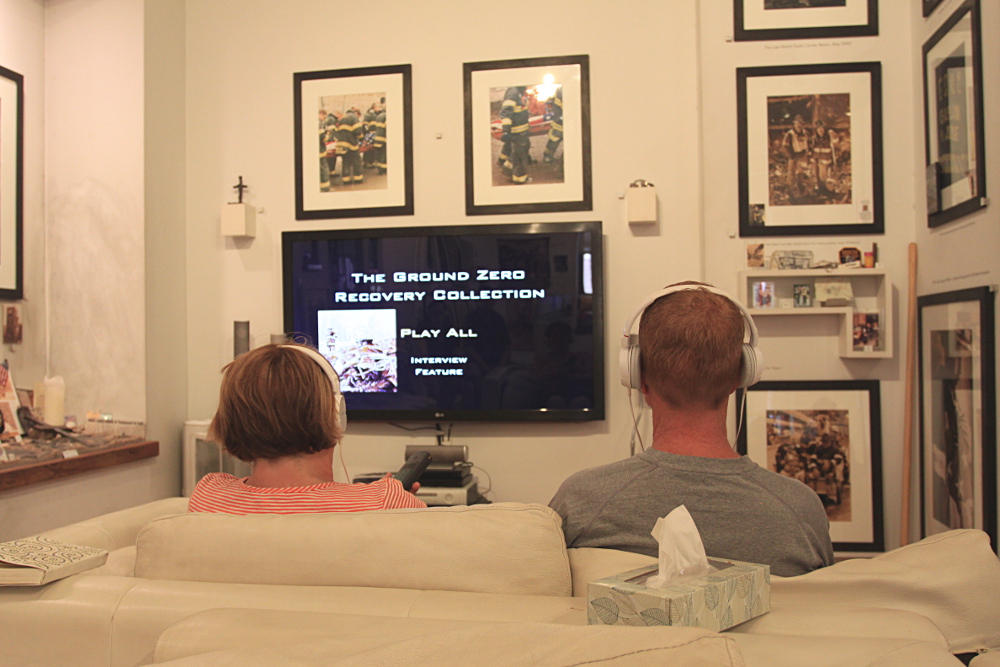
The museum has tissues ready… (Photo Didier Forray)
A Collection of Objects from September 11, 2001
- Sad, haunting music fills the room. I look at the visitors and see that everyone has grown serious. The guide senses this heavy atmosphere that has suddenly fallen over the group. He looks at us with a big smile and, surprisingly, says: “don’t be sad, we simply need to remember what happened!” A simple phrase that really lightens the mood.
- He then offers to show some of the photographs and objects on display. To start, he stops at crosses cut from pieces of the World Trade Center’s steel beams. It’s an emotional moment when the guide invites each person to hold these pieces of metal. “You’re holding a piece of history,” he says simply. Another striking object: clusters of glass fragments that covered the facade of the two towers. “Contrary to what you might think, very little glass was actually found at the Ground Zero site because it all vaporized during the collapses,” the guide continues. “In total, if you gathered all the glass pieces collected during the search, you’d barely have enough to fill a car trunk.”
- The guide goes on to show strange beer cans from the 1970s. “They’re from when the World Trade Center was being built, and the workers hid them between the steel beams,” he explains.
- Finally, here is the most important piece: among the objects is a small fragment from one of the planes that crashed into the World Trade Center. “I ask just one thing,” the guide says, “please don’t photograph this piece.” Everyone respects this request.
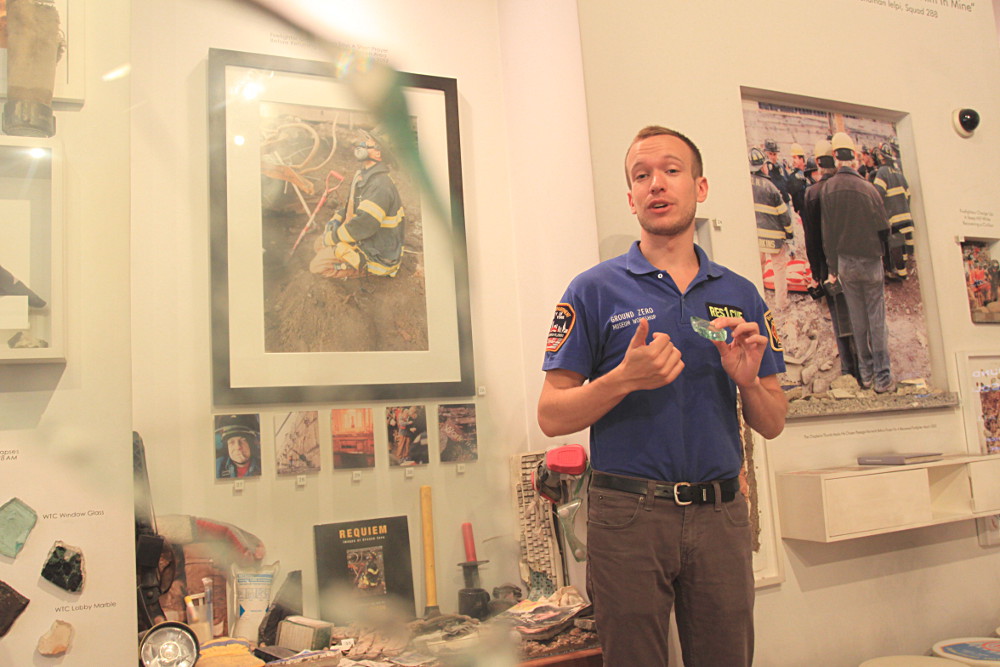
A piece of glass from the World Trade Center. (Photo Didier Forray)
An Exhibition to Explore at Your Own Pace
- After this overview of the main objects, the guide invites everyone to explore the exhibition at their own pace. Take your time: you can stay as long as you like! With an audio guide, you simply enter the number corresponding to each object to hear Gary Marlon Suson’s commentary.
- The audio guide is available in French, but if you speak English, I strongly recommend choosing English so you hear the photographer’s own voice. He tells you the context of each image and the story behind each object. The narratives are fascinating and full of details and anecdotes. The Ground Zero Museum Workshop offers a completely different way to understand September 11, 2001, focusing on the search and rescue operations rather than just the timeline of events.
- One tip: also take a look in the restroom. To the left of the sink, you’ll see the honorary battalion chief diploma from the New York Fire Department that was awarded to Gary Marlon Suson. I asked the guide why this honor is displayed in such a place—a very clean one, certainly, but not the usual spot for such recognition. “It’s Gary’s request,” the guide answered with a smile. “He wants the heart of the museum to be dedicated to the events, so he asked to be placed in the worst possible location—the restroom.” A beautiful lesson in humility!
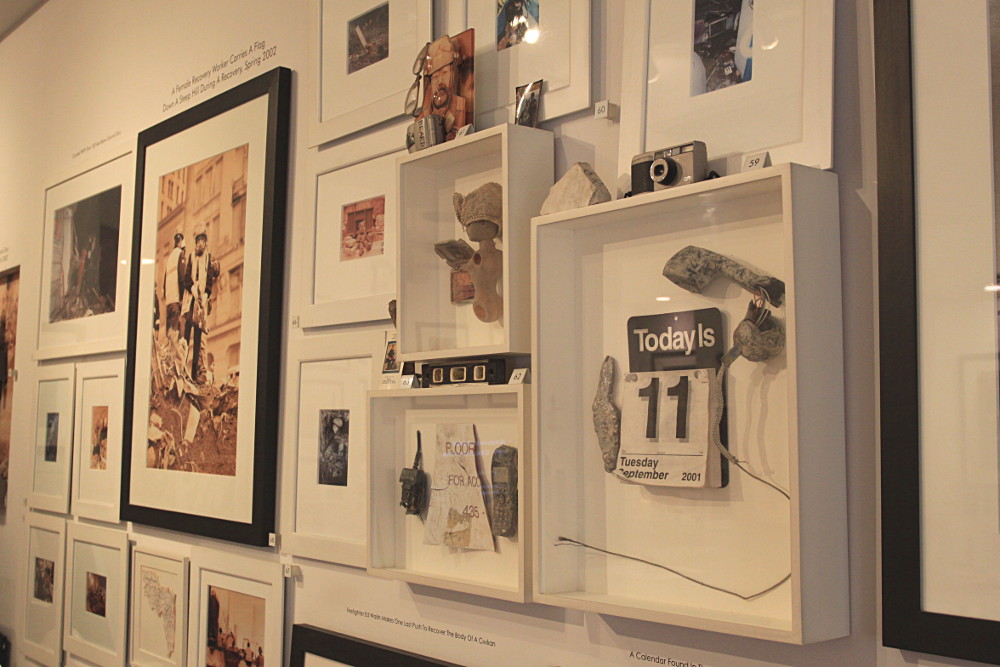
A calendar found in the rubble. (Photo Didier Forray)
Ground Zero Museum Workshop in Video
To get a sense of the space and atmosphere, here’s a video I made:
